
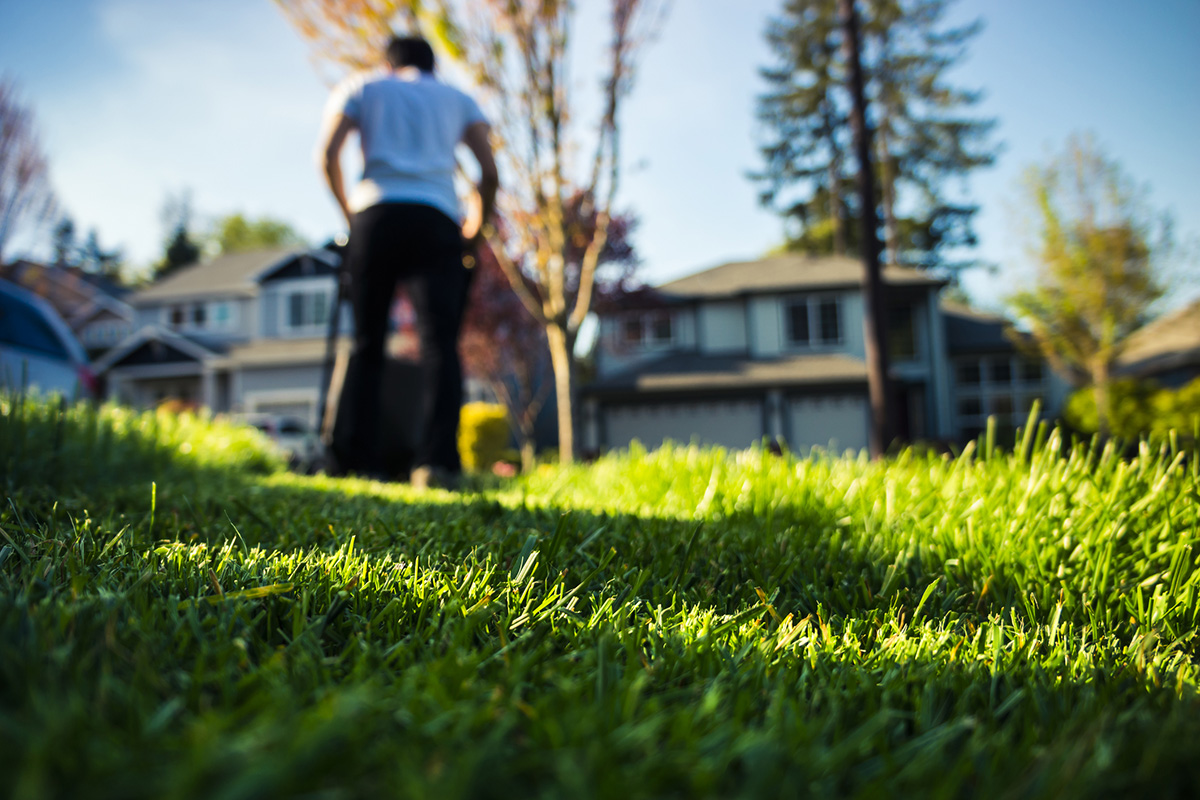
A few simple steps can help ensure that your new lawn has a chance to establish itself and stay healthy.
Because new sod has very short and limited roots, frequent and short watering cycles will only result in short-rooted, poorly established grass. In properly prepared soil that is watered deep, sod will quickly take root and push down deeper and have deeper roots.
The first few weeks after installing sod are critical to proper establishment. Each species of grass has its own “care and feeding” requirements. Knowing when and how to mow, fertilize and water your new lawn is important.
Watering
Weather conditions will dictate the amount and frequency of watering. Be certain that your new lawn has enough moisture to survive hot, dry, or windy periods. Water areas near building more often where reflected heat dries the turf.
Give your new lawn at least 1 inch of water within 1/2 hour of installation. Water daily, or more often, keeping turf moist until it is firmly rooted (about 2 weeks). Then less frequent and deeper watering should begin.
Check for Dry Spots
Even a new in-ground irrigation system can be less than perfect, and hose-end sprinklers are even more notorious for their lack of uniform distribution. Dry spots may take several days to appear, and if you aren’t looking for these problems you could have dead grass in a matter of days.
Avoid Heavy Use
While grass is not that fragile after it’s properly installed, some caution is necessary. During the first three weeks, avoid heavy or concentrated use of your new lawn. This gives the roots an opportunity to firmly knit with the soil, and insures that the turf will remain smooth.
Walking across a soggy, new lawn can compress the soil, but most often it leaves a series of depressions in the lawn that may never fully recover. Also, any lateral movement or shearing (running around on the sod by humans or dogs!) should be avoided for the first four to six weeks.
Your new sod lawn increases your property value significantly. With proper care, it will remain a great asset, providing beauty, a clean playing surface, and an improved environment.
Mowing
Mow often, generally removing no more than 1/3 of the grass height at a mowing. Keep your mower blade sharp. Follow mowing recommendations for your type of lawn.
Your turf was conditioned to about 2 inches in height of cut, and mowed just prior to harvest and delivery by the sod producer. With new turf or sod, you may need to mow it about 2-3 days after it is installed but this will vary based on the type of sod. What is important is that you are both consistent and frequent. You can almost never mow the grass too often.
It is also recommended that you practice grass recycling by leaving the clippings on your lawn. Grass clipping are extremely rich in nutrients and can actually feed your lawn. It is not necessary to collect your clippings unless they cover the grass and block the sunlight from reaching the green leaves. By returning grass clippings to the turf in small amounts, you actually create a healthier turf. Grass clippings do not contribute to make thatch. In fact, by adding them back to the turf, your thatch will form slower. Grass cycling also benefits the environment, improves your lawn, saves time and save landfill space.
Fertilizer
Fertilizer and chemical applications will depend on climate, sod type, soil, insects, weed and disease conditions.
Fertilizers are usually designated by three numbers printed on their container. The three numbers refer to the percentage of the product in the container that is nitrogen (N), phosphorus (P), and potassium (K). The numbers are always in the same order: N; P; K. For example, if a 30 lb bag of fertilizer lists the N:P:K as 10:7:3 (these numbers are percentages), this means that the bag has 3.0 lbs of nitrogen (30 lbs X 0.10); 2.1 lbs of phosphorus (30 lbs X 0.07); and 0.9 lbs of potassium (30 lbs X 0.03).
It is generally recommended that you use a fertilizer with all three elements, but check with your local garden center turf expert for some help with both the selection and calculations for applying fertilizer. There are many reasons why grass does not grow properly, and lack of sufficient nutrients is only one possible cause. If you are not satisfied with the results after fertilizing your lawn, consult a turfgrass expert, or your local extension agent.
Follow these guidelines and you’ll have the lawn of your dreams, one that is environmentally friendly, requires very little in the way of long-term maintenance, and adds value and beauty to your property.